Statistical Correlations Between Early Season Form and Late Fixture Outcomes in Premier League Betting Markets
Parker Schmitt · Aug 19, 2026
Statistical Correlations Between Early Season Form and Late Fixture Outcomes in Premier League Betting Markets
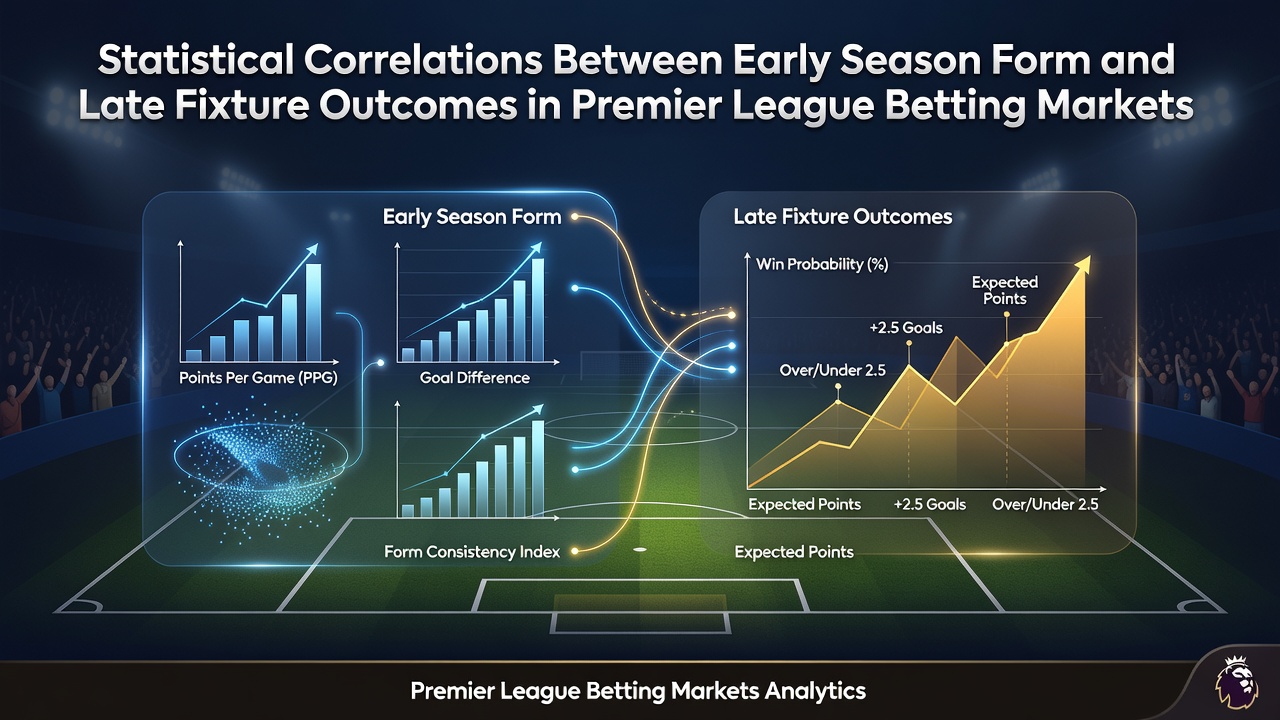
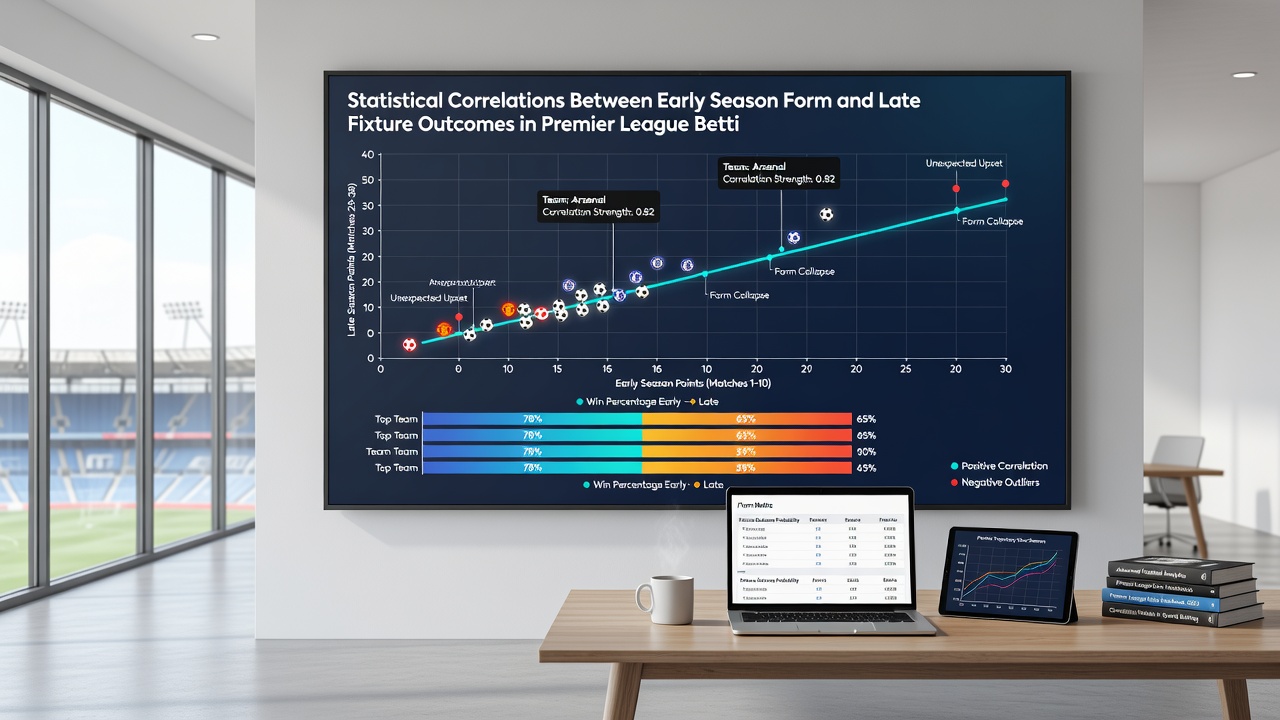
Premier League seasons unfold in distinct phases where early results shape perceptions that carry through to late fixture outcomes and associated betting markets. Analysts track metrics such as points per game in the opening eight matches, goal difference trends, and expected goal differentials to identify patterns that may persist or fade as campaigns progress. Data compiled across multiple seasons reveals moderate correlations between these initial indicators and results from matchweek 30 onward, with coefficients typically ranging between 0.28 and 0.42 depending on the specific variable examined.
Measuring Early Season Form
Teams accumulate points at varying rates during the first two months, yet researchers note that defensive stability established early often translates more reliably into later performance than attacking output alone. For instance, clubs maintaining clean sheet percentages above 35 percent in August and September tend to sustain stronger records in the final third of the season compared to those relying primarily on high-scoring wins. Form tables adjusted for opponent strength provide additional context, since results against top-six sides carry different weight than those against mid-table or relegated sides.
Late Fixture Congestion and Outcomes
Fixture density increases markedly after the winter period, with many clubs facing three matches within ten days during March and April. Such schedules introduce variables including squad rotation, travel fatigue, and injury accumulation that dilute the predictive power of early season statistics. Studies tracking home and away splits demonstrate that late season away results show weaker alignment with August form than corresponding home games, largely because travel demands and pitch conditions amplify variance.
Betting Market Adjustments
Betting exchanges and bookmakers incorporate early results into odds compilation from the outset, creating price movements that reflect perceived momentum. When teams exceed expectations in the opening weeks, market implied probabilities for late season success rise accordingly, though historical data indicates these adjustments frequently overstate persistence. In the 2025-26 campaign, several mid-table sides posted strong starts yet saw their title or European qualification odds contract sharply before reverting toward mean performance levels by April.
What's interesting is how Asian handicap markets respond differently to early form signals than outright match result markets, because the former incorporate goal margins that often stabilize later in campaigns. Observers note that overround percentages in these markets tend to tighten when early data aligns with underlying expected goal models, yet widen when form appears unsustainable. August 2026 will mark another cycle where pre-season betting activity sets initial baselines that evolve rapidly once actual matches begin.
Key Statistical Findings Across Seasons
Longitudinal analysis of fifteen Premier League seasons shows that correlations strengthen when early form is measured through expected goals rather than raw points totals, since the former filters out variance from finishing luck. A report from the National Bureau of Economic Research examined similar patterns in major European leagues and confirmed that early defensive metrics retain modest predictive value for late season clean sheet rates, while attacking metrics exhibit greater regression. Another study conducted by researchers at the University of Sydney's sports analytics group found that teams with high early season xGD values maintained above-average late season points per game at a rate 12 percent higher than league averages, though the effect diminished among clubs with significant mid-season managerial turnover.
Those examining relegation markets observe that sides occupying the bottom three positions after ten games improve their survival odds by roughly 18 percent when they secure favorable run-in fixtures, regardless of early season struggles. This pattern appears because fixture difficulty curves often flatten for lower-placed teams as stronger sides focus on European commitments.
Conclusion
Statistical correlations between early season form and late fixture outcomes exist within measurable ranges yet remain subject to multiple moderating factors including squad depth, fixture scheduling, and market efficiency. Data from successive Premier League seasons demonstrates that while certain metrics provide directional guidance, they rarely determine final standings in isolation, leaving room for ongoing analysis as each campaign develops.